Quintel Blogger theme

A free Premium Blogger theme.

Showing posts with label US Cellular. Show all posts

Sunday, July 14, 2013

Bullet Point Analysis: The AT&T-Leap Buyout


What is it?


AT&T is buying prepaid player Leap Wireless for $15 per share in cash. Under the terms of the agreement, AT&T will acquire all of Leap’s stock and wireless properties, including licenses, network assets, retail stores and approximately 5 million subscribers. AT&T expects the transaction to complete in 6-9 months (1H 2014).

What is in it for Leap?


  • For shareholders and management, they can exit the cut throat prepaid business with money. Leap and similar regional prepaid player, MetroPCS, had once enjoyed strong growth until a couple of years ago. National competitors and prepaid MVNOs ate into their marketshare and growth. T-Mobile's acquisition of MetroPCS that closed in May 2013 logically put a brighter spot light on Leap. 
  • For Leap operations, the Cricket brand expands its geographical reach beyond Leap's limited regional footprint and can go head-to-head against MetroPCS and can tap into AT&T's distribution resources.
  • For the Leap network, it has a clearer LTE path. Operating CDMA (96M POPs) and LTE (21M POPs) in the same limited AWS spectrum bands doesn't work well.   

What is in it for AT&T?


Spectrum:  

  • Complementary PCS and AWS bands covering 137M POPs, some of AWS is not in service (41M POPs).
  • Proceeds from the Leap 700 A Block spectrum goes into the deal calculus.


Subscribers and Doors: 
  • Leap has 5 million prepaid subscribers but the company has been trying to right itself after steady customer losses that began in Q2 2012. AT&T increases its prepaid customer base to roughly 12 million, roughly 11% of the AT&T total subscriber base.
  • Leap's distribution channel numbers a little less than 9,000 doors.  
  • Commentary: Leap's business needs a turnaround that Leap's management has been trying to accomplish for more than a year. In that time, Leap lost about 900K customers. Leap's distribution also slimmed down from over 11K doors in a bid to focus customer acquisition.  AT&T's own branded prepaid is not growing. The launch of the Aio brand in May allows for the company to enter the prepaid market aggressively without diminishing the AT&T brand. Now that Leap joins the AT&T prepaid fight, the strategy is shaping up to match the segmentation strategy pioneered by Sprint (Boost, Virgin, Assurance) and Tracfone (Tracfone, StraightTalk, Net10, Simple Mobile, PagePlus, and Safelink). T-Mobile also joins in the prepaid segmentation fight with its own GoSmart and MetroPCS).  All this Tier-1 competition and the plethora of MVNOs out there vying for the prepaid share of wallet will make for thin margins.  
Strategic Positioning:

Keeping T-Mobile Away: There are many who say this is a spectrum deal. That is true that additional PCS and AWS spectrum enhances the AT&T network, I argue that a large element is to neutralize a growing T-Mobile threat. Fresh off the May close of MetroPCS, T-Mobile supplemented its AWS spectrum with a $308M deal with US Cellular at the end of June.  
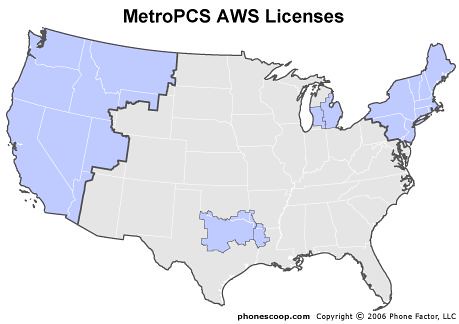
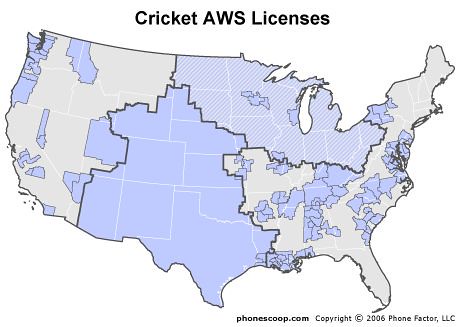
    To understand it roughly, rewind back to the ongoing speculation that a then independent MetroPCS and Leap were a perfect fit since both had the same prepaid business models and did not compete against each other for the most part. The results of the 2006 AWS auction (see graphics below) helped fuel this speculation as the AWS  MetroPCS and Leap spectrum fit provided an uncannily perfectly complement. Time has passed and some AWS licenses changed hands. 


      Graphics from Phonescoop.com
      But with the AT&T-T-Mobile merger breakup, T-Mobile received some AWS licenses and in 2012, Leap and T-Mobile traded some licenses. While the T-Mobile-MetroPCS coverage map looks empty in some areas of the country, that is not to say that the company lacks spectrum in those areas. 
      As seen in the spectrum holdings graphic, the company does indeed have spectrum nationally and can expand if so desired.  


      With the June purchase of Mississippi Valley AWS spectrum from US Cellular (Barat) Wireless) and a future rumored purchase of Leap, the T-Mobile AWS portfolio would be formidable. Aside from T-Mobile, archrival Verizon Wireless' SpectrumCo AWS deal completed in August 2012 and building out this AWS to add LTE network capacity.  


      This competitive landscape would put AT&T in an AWS coverage disadvantage relative to T-Mobile and Verizon Wireless. Therefore, AT&T needed to stay in the AWS LTE game and keep T-Mobile from growing a stronger AWS portfolio. For AT&T, AWS will not only to serve to add LTE capacity customers but also tap into future AWS LTE roaming revenue. T-Mobile, AT&T and Verizon Wireless are logical future roaming partners.  


      Which companies will feel the most impact?

      • For T-Mobile, with Leap as a unit of AT&T, its MetroPCS geographic expansion will be challenged by AT&T's resources.  T-Mobile seemingly has a year or two lead as it is integrating MetroPCS and working on migrating the CDMA base to HSPA+/LTE but the stated goal of 2015.
      • Sprint will lose 3G data wholesale revenue from the agreement forged in August 2010 that expires in Dec 2015. But now Sprint (Clearwire's owner) loses another wholesale arrangement that Clearwire announced in March 2012 though nothing really started.  It's clear now that Sprint's prepaid segmentation strategy was the correct in the long run but Aio Wireless and Cricket are going up against Virgin, Boost, Assurance, respectively. Cricket's logical national (or specific target market) expansion may spell trouble. 
      • Verizon Wireless now sees a stronger AT&T rival with new found AWS and PCS spectrum from Leap. In the long term, it needs additional spectrum to thwart impending capacity brought on with WCS and Channel 55 (700 from Qualcomm) frequencies. In terms of prepaid, its branded prepaid is holding its own but without any flanker brands, competitors will take almost all the future prepaid growth.
      • In infrastructure, AT&T LTE equipment suppliers, Alcatel and Ericsson now have more of an order pipeline than before.

      Last Word

      • The biggest question in this deal is whether the acquisition will pass regulatory hurdles. The sting of the failure to acquire T-Mobile is still fresh in everyone's minds. Like any major deal, it should have been gamed out by M&A internal and external resources taking into account the regulatory environment before it makes the light of day. 
      • If regulatory hurdles are overcome, what conditions will there be? AT&T has proactively said that the Chicago 700 MHz A Block will be sold. (It doesn't like the A block anyway). Will the company need to divest in other markets (planned or unplanned)? 

      Monday, March 11, 2013

      4Q2012 Prepaid Carrier Trends – Be Warned – It’s A Long One

      Now that the Q4 2012 earnings are done, let’s look at the segment that had been driving a lot of the wireless growth in the past few years – prepaid. Rewind back to 2007/2008, Leap and MetroPCS were strongly acquiring subscribers with their unlimited propositions. The subsequent years saw similar flat rate introductions from the likes of Boost, Virgin Mobile, Tracfone’s StraightTalk and NET10. With the pressure from the monthly prepaid plans, Tier 1 carriers Verizon Wireless, AT&T and T-Mobile also joined the mix. The commonality in competition is for the high-value user. The traditional pay-as-you-go (PAYG) user’s contribution is far less. These users range from ‘glove box’ (low use) to moderate users. They also tend to be highly price sensitive and have a higher churn profile. The opposite is true to monthly plan users. These users while also price sensitive are heavier users and are fine with a flat rate model for predictability. They often have a lower churn profile relative to the PAYG user. That’s not to say they’re in the postpaid sub 2% churn territory. But for the prepaid segment, these monthly users are lower churn. 

      Smartphones have been appearing in the prepaid segment for the last two years. While the companies want to offer the same capabilities as the postpaid segment, the prepaid model calls for low to no subsidies on devices. Of course companies strive to find low cost providers (e.g., Huawei and ZTE) to fill that niche and to leverage price against existing suppliers (e.g., Samsung, LG, Kyocera, HTC, etc.). The goal of course is to drop the smartphone price so that buyer can perceive that they’re affordable. However, prepaid providers walk a fine line for inexpensive devices because if a device is perceived as almost a throwaway, the likelihood of churn increases. For those reasons, expensive halo devices like a Samsung Galaxy S3 or the Apple iPhone keep the carrier sticky. 
      With this as a backdrop, let’s look at how the players fared? Purely on net addition numbers, we can see that the regional unlimited players that ruled the day back in 2007/2008 are in trouble with Leap Wireless in the poorest shape with over 300K in subscriber losses. In Leap’s earnings call they noted that they are de-emphasizing their pay-as-you-go and mobile broadband business. There is logic in this as mobile broadband users eat more bandwidth (leaving less for monthly users) and PAYG are less revenue generating. MetroPCS though with less subscriber loss follows the same loss trend that has plagued Leap for many quarters. The company claims that they’re de-emphasizing CDMA growth but this tactic has resulted in an overall 5% loss in the base. This meshes with the long term strategy anyway once T-Mobile integrates and eventual use the 1900 CDMA to convert to 1900 HSPA+. By contrast, Tracfone’s net additions are by far the most impressive. The company buys wholesale from many carriers and has a large mix of PAYG and a growing base of monthly users. Presumably StraightTalk is doing well for the company as evident in ARPU. Several years ago, Tracfone ARPU was 10. In Q4 2011, it was 16 and in Q4 2012, it is now 18. APRU just doesn’t jump like this by growing a purely PAYG product. 


      While Verizon Wireless had a tremendous Q4 in the postpaid side with over 2.1M net adds, the positive prepaid numbers indicate their competitiveness. Despite a down from a year ago and the previous quarter, it speaks to their premium brand messaging and perhaps a new November double data plan promotion. This is pretty decent for a predominately postpaid company. AT&T on the other hand is on a steeper downward slide. In Q3 2012, the company added 77,000 users with those gains erased with the 166K lost in Q4. AT&T is still a postpaid company with prepaid making up around 7% of the total subs. It will be interesting to see which way the direction turns for AT&T in Q1 2013. Another predominately postpaid carrier doing well in prepaid is US Cellular. Though the regional carrier continues to shed postpaid subscribers, the new U Prepaid plans that it has partnered with Alltel may be helping the cause. 

      Moving onto the rest of the carriers, Sprint’s prepaid numbers have been down relative to previous quarters because the Assurance brand that had been driving huge subscriber count has been slowed due to FCC’s revamping of the subsidized Lifeline program in 2012. The company has already warned of a 1.2-1.3M subscriber loss possibly in Q2 2013 due to the revamping of rules. Regardless, the company indicated that the Boost and Virgin Mobile brands have contributed to the positive numbers. At the same time, the company is actively trying to migrate older Boost iDEN users off ahead of the iDEN network decommissioning. Finally, T-Mobile’s prepaid business is offsetting continued losses (550K) on the postpaid side. Again the above numbers are branded prepaid. T-Mobile counts MVNO (wholesale) net additions as prepaid as well. Branded prepaid at end of year 2012 represented 17% of the overall T-Mobile base. Looking ahead with the combination of MetroPCS’ prepaid subs, branded prepaid will transform to 45% of T-Mobile’s subscriber count. Given the higher churn profile of prepaid and lower revenue, it’ll looks challenging for future higher revenue contribution. But that’s months away…. Q1 2012 typically continues Q4 sales momentum. We’ll visit that to see what develops.

      Thursday, March 7, 2013

      US 4Q2012 Carrier Results - Google Hangout with RCR Wireless

      Dan Meyer, Editor in Chief of RCR Wireless asked me to discuss Q4 2012 carrier results and some thoughts on some future direction.


      Sunday, February 3, 2013

      Substantive Switching Credit

      I just caught this switching ad from Sprint. I found it through a Facebook ad.  The promise is to receive $400 credit for switching a family plan with 3-5 lines. It reprises a similar $400 effort reported in August 2012. While switching credits are nothing new, the $400 figure is notably high to entice. 

      Sprint Switching Ad 


      Sprint isn't the only carrier in the switching game for Q1 2013. US Cellular at the end of January launched a $300 switching promotion.   


      What is the motivation?

      • Postpaid Penetration - Carriers have long talked about the near saturation of the postpaid marketplace. In this world, organic growth has slowed and the only way to get net additions will be to steal it away from other carriers. 
      • Quarterly (Q1) Performance - Both Sprint and US Cellular have been losing customers at a rapid rate.  Sprint's iDEN customer defections have been a thorn in its side for 3+ years.  US Cellular as a regional carrier has not been effectively competing against Tier 1 competitors despite upgrading to LTE and upgrading its device portfolio.
      • Families are Low-churn & High ARPU-bearing - The promotion grabs 3-5 subscribers and the carrier locks them in for two years. The promotions specifically push customers into smartphones and data plans. Data is the monetary upsell and the sticky value-prop. 
      • Promotion Credit Sunk Marketing Cost - In business, there needs to be promotion to draw interest to your product. Some companies have different tolerances for the cost to acquire a customer.  At the end of the day for Q1, Sprint and US Cellular need to beef up their gross adds.  

      Friday, January 25, 2013

      Spectrum Win-Win for Two Giants

      Today AT&T agreed to acquire spectrum in the 700 MHz B band from Verizon Wireless for $1.9 billion in cash and Advanced Wireless Services (AWS) spectrum licenses in several markets, including Phoenix, Ariz., Los Angeles and Fresno, Calif. and Portland, Ore.


      The 700 MHz licenses to be acquired by AT&T cover 42 million people in 18 states — California, Colorado, Florida, Idaho, Illinois, Louisiana, Montana, New Mexico, New York, Ohio, Oklahoma, South Dakota, Tennessee, Texas, Utah, Virginia, Washington and Wyoming.  Here are the following CMAs (Cellular Market Areas):

      ·         California: Los Angeles
      ·         Colorado: Park, Fort Collins-Loveland, Pueblo,
      ·         Florida: Miami, West Palm Beach, Bradenton
      ·         Idaho: Butte
      ·         Illinois: Chicago
      ·         Louisiana: De Soto, Claiborne, Morehouse, Lake Charles, Alexandria
      ·         Montana: Billings, Beaverhead, Great Falls, Carbon
      ·         New Mexico: Grant
      ·         New York: Rochester
      ·         Ohio: Cincinnati, Youngstown
      ·         Oklahoma: Oklahoma City
      ·         South Dakota: Rapid City, Harding
      ·         Tennessee: Memphis
      ·         Texas: Texarkana, Edwards, Waco, Tyler, Longview-Marshall
      ·         Utah: Box-Elder, Carbon, Beaver, Piute
      ·         Virginia: Frederick
      ·         Washington: Okanogan
      ·         Wyoming: Sheridan, Casper

      Yet another interesting sideline is the involvement of a Sarasota, FL private equity firm, Grain Management.  Verizon is selling spectrum in several North Carolina markets to Grain Management. Grain is also acquiring an AWS license covering Dallas from AT&T—and Verizon will lease that license from Grain.
      Recall in Auction 73, the Lower 700 Band was up for grabs.  

      How did Verizon do?


      • Block A – Verizon Wireless and U.S. Cellular both bought 25 licenses each. In this block, Verizon targeted urban areas, while U.S. Cellular bought licenses primarily in the northern portion of the U.S. 
      • Block B – AT&T Mobility was the biggest buyer in the B block, with 227 licenses totaling $6.6 billion. U.S. Cellular and Verizon bought 127 and 77 licenses, respectively. AT&T Mobility and Verizon Wireless bought licenses around the country, while U.S. Cellular continued with its strategy to buy licenses in northern regions. 
      • Block C – Of the 10 licenses in the C Block, Verizon Wireless bought the 7 that cover the contiguous 48 states (and Hawaii). Those seven licenses cost Verizon roughly $4.7 Billion. 


      Why? It's a win-win because Verizon Wireless wanted to unload the 700 MHz bands (A and B Block) as its C Block and its recent AWS spectrum acquired from Cable Company partners gave a sufficient footprint nationally.  AT&T needed it to fill B Block holes nationally.  It was almost a given that AT&T would be the buyer. As an aside, earlier this month,  Verizon sold some A Block licenses to US Cellular. 

      The interesting go-between of a private equity firm is notable.  It's clear that PE firms do not operate networks but a licensing/leasing arrangement from these big carriers will bring in recurring revenue.