Quintel Blogger theme

A free Premium Blogger theme.

Showing posts with label AWS. Show all posts

Thursday, January 2, 2014

LTE Speed Titles

AT&T has already taken the LTE speed mantle for 2013.  I think that speed will continue to be an important marketing differentiation.  Sprint Spark, based on 2.5 GHz spectrum as that opportunity to break Sprint out of its downward slide.  


My article in RCR Wireless entitled LTE Speed Crowns and Network Dependencies lays out some of my thoughts.  A key piece in increasing speed is when carrier aggregation kicks in. In a nutshell,   it's the ability to piece together disparate pieces of a carrier's spectrum portfolio to make a 'fatter pipe' in order to deliver to the user, a faster speed (and lower latency) experience. Of course there are a lot of hardware dependencies that go into it.

While speed is exciting, what looks to be a Sprint win may be a marketing and revenue loss in the non-metropolitan areas.  That is due to 2.5 GHz's poor propagation characteristics.  It just cannot reach out there and Sprint's problem is that thought it has a lot of the frequency, in order to make it effective nationally, they would have to expend a LOT more money to blanket the U.S. geography. This is a similar argument that you don't see a fully geographic national PCS network.  Verizon Wireless and AT&T will have that advantage with their sub-1GHz portfolio. When these larger carriers piece their deep cellular bands with their 700 spectrum, they will have the ability to deliver greater speed than Sprint outside of the metropolitan areas.  This won't happen for a couple more years late 2015-2017, perhaps.   

Sprint will need to execute on its 2.5 GHz Spark buildout to have a shot at the standard speed surveys that Root Metrics (various metro updates over the course of the year) and PC Magazine (May) performs. It may be that Sprint will win some important metros but may not get the 2014 title until those survey cities are 'Sparked.'  Throwing a monkey wrench in 2014 will be Verizon Wireless and T-Mobile tapping their deep AWS assets. T-Mobile has already been reported to have a 20 X 20 (20 MHz down/20 MHz uplink) in the Dallas area while Verizon Wireless has turned on  20 X 20 in New York.

When Spark reaches some critical market threshold, I fully expect Sprint to turn up the marketing to push speed and unlimited.(And introduce a deep Tri-band device portfolio). It should definitely appeal to the technology forward users.  I'm also thinking that the tech blogs should help the cause. Of course, it depends on getting that network going. 

2014 will be an interesting speed year.  

Thursday, July 25, 2013

Bullet Point Analysis: MetroPCS's 15 New Market Expansion & New Handsets

MetroPCS had multiple announcements. The first announcement focuses on expanded its smartphone portfolio with the Nokia Lumia 521 ($99) and LG Optimus F3 ($149). While handset announcements are less than notable on a strategy, there are small tidbits that one can glean. They are:

  • The  smartphones are not CDMA. This is a step to migrate the subscriber base to the T-Mobile network (100% goal in 2015) .
  • The Lumia is an HSPA+ only device and comes from the T-Mobile prepaid device stable. Moreover, it give MetroPCS a Windows Phone choice.
  • The LG Optimus F3 is HSPA+/LTE. Other carriers have the F3 in CDMA configuration. The F3 has better processor specs than the postpaid Optimus L9 offering. So the prepaid version bests a postpaid offering, albeit a tad smaller (4" vs 4.5" screen).   

The second press release was more interesting.  MetroPCS announced 15 new markets, expanding their total market reach to 30 markets.  With this announcement, the company has opened up for business in those markets along with distribution.  However, Metro will wait until September 1 for their advertising push. 

Of the 15 markets, 8 are Leap markets. T-Mobile's CEO has talked up a head-to-head match up against Leap. Interestingly some are in Texas, a Leap stronghold. One symbolic market that stands out is San Diego - Leap's corporate headquarters.  Key to the success will obviously be distribution - big box stores such as Best Buy and third party retailers. The company is looking for 200 doors in August with more in the fall.
  • Baltimore, MD - Head-to head against Leap/Cricket
  • Birmingham, Ala. - New market without retail Leap presence; Next major city that links up with Atlanta market
  • Cleveland and Akron, Ohio - adds to Great Lakes coverage
  • Corpus Christi, Texas - Head-to head against Leap/Cricket
  • Fresno, Calif. - Head-to head against Leap/Cricket
  • Houston, Texas - Head-to head against Leap/Cricket
  • Memphis, Tenn. - Head-to head against Leap/Cricket
  • New Orleans, LA  - New market without retail Leap presence
  • Rio Grande Valley, Texas  - Head-to head against Leap/Cricket
  • San Antonio and Austin, Texas - Head-to head against Leap/Cricket
  • San Diego, Calif. - In Leap's backyard (its headquarters)
  • Seattle and Tacoma, Wash. - In T-Mobile's HQ area, no brainer in opening up distribution in the parent's backyard; New market without retail Leap presence
  • Tallahassee, Fla. - Rounds out MetroPCS's Florida coverage. New market without retail Leap presence
  • Toledo and Sandusky, Ohio - adds to Great Lakes coverage; New market without retail Leap presence
  • Washington, DC - Head-to head against Leap/Cricket

Tuesday, July 16, 2013

AWS Spectrum Maps - Before and After: AT&T-Leap Buyout

In yesterday's post, we saw the results of a combined entity spectrum depth map that displayed the 700MHz, Cellular, PCS and AWS bands.  However, one of the points I brought up was AT&T staying in the AWS spectrum game for LTE capacity fill in (to 700) and to position itself from an AWS LTE roaming standpoint. In this post, we are fortunate to show the AWS holdings for Leap and AT&T. 

Leap AWS spectrum

AT&T AWS spectrum

Combined AT&T-Leap AWS spectrum


What have we concluded? Specifically, the AWS national footprint still far from filled as evidenced by the white on the map. Once AWS LTE roaming happens, AT&T has the option to fill those areas, if necessary.

Despite the AWS gaps, we can see that Leap will strength AT&T LTE in specific markets such as:
  • (West) Seattle, central California, San Diego, Salt Lake City, Denver
  • (Southwest) Las Vegas, Phoenix, Tuscon, Sante Fe, El Paso
  • (Midwest) Kansas City, Omaha, Chicago, Milwaukee, St. Louis, Cincinnati, Louisville, Nashville
  • (South-ish) San Antonio, Ok City, New Orleans, Little Rock, Memphis, Hashville   
  • (Mid-Atlantic) Baltimore, Philadelphia, Washington, DC, Richmond, Charlotte, Raleigh, Columbia
  • (East-ish) Buffalo, Pittsburgh
Again, the combined AT&T-Leap spectrum depth map (note this excludes WCS spectrum)


Thanks to Mosaik for their output.

Monday, July 15, 2013

The AT&T-Leap Spectrum Depth (A Map View)

Spectrum is indeed a prime factor in any wireless carrier acquisition. Spectrum maps play an important role in understanding deal motivation and what the resulting merged entities' national spectrum depth looks like.

The Leap spectrum view:
Though Leap's spectrum (mainly PCS and AWS (the 700 in Chicago is for sale)) goes beyond their operating regional markets, the company's business model focuses in on densely populated markets. 

The AT&T spectrum view:
The combined AT&T-Leap spectrum view:


With the Leap spectrum, AT&T is strengthened in some heavily contested markets including, the Mid-Atlantic, central California, Las Vegas (better AT&T service at CTIA?), Denver, KC (Sprint's backyard), St. Louis (Sprint's newest market acquisition from US Cellular), and Northwest (Seattle - T-Mobile's backyard). Of course, the big question is will spectrum need to be divested?  The Department of Justice uses the Herfindahl-Hirschman Index (HHI) to measure market concentration for purposes of antitrust enforcement.  

Note: Thanks to Mosaik for the use of their MapElements output. 

Sunday, July 14, 2013

Bullet Point Analysis: The AT&T-Leap Buyout


What is it?


AT&T is buying prepaid player Leap Wireless for $15 per share in cash. Under the terms of the agreement, AT&T will acquire all of Leap’s stock and wireless properties, including licenses, network assets, retail stores and approximately 5 million subscribers. AT&T expects the transaction to complete in 6-9 months (1H 2014).

What is in it for Leap?


  • For shareholders and management, they can exit the cut throat prepaid business with money. Leap and similar regional prepaid player, MetroPCS, had once enjoyed strong growth until a couple of years ago. National competitors and prepaid MVNOs ate into their marketshare and growth. T-Mobile's acquisition of MetroPCS that closed in May 2013 logically put a brighter spot light on Leap. 
  • For Leap operations, the Cricket brand expands its geographical reach beyond Leap's limited regional footprint and can go head-to-head against MetroPCS and can tap into AT&T's distribution resources.
  • For the Leap network, it has a clearer LTE path. Operating CDMA (96M POPs) and LTE (21M POPs) in the same limited AWS spectrum bands doesn't work well.   

What is in it for AT&T?


Spectrum:  

  • Complementary PCS and AWS bands covering 137M POPs, some of AWS is not in service (41M POPs).
  • Proceeds from the Leap 700 A Block spectrum goes into the deal calculus.


Subscribers and Doors: 
  • Leap has 5 million prepaid subscribers but the company has been trying to right itself after steady customer losses that began in Q2 2012. AT&T increases its prepaid customer base to roughly 12 million, roughly 11% of the AT&T total subscriber base.
  • Leap's distribution channel numbers a little less than 9,000 doors.  
  • Commentary: Leap's business needs a turnaround that Leap's management has been trying to accomplish for more than a year. In that time, Leap lost about 900K customers. Leap's distribution also slimmed down from over 11K doors in a bid to focus customer acquisition.  AT&T's own branded prepaid is not growing. The launch of the Aio brand in May allows for the company to enter the prepaid market aggressively without diminishing the AT&T brand. Now that Leap joins the AT&T prepaid fight, the strategy is shaping up to match the segmentation strategy pioneered by Sprint (Boost, Virgin, Assurance) and Tracfone (Tracfone, StraightTalk, Net10, Simple Mobile, PagePlus, and Safelink). T-Mobile also joins in the prepaid segmentation fight with its own GoSmart and MetroPCS).  All this Tier-1 competition and the plethora of MVNOs out there vying for the prepaid share of wallet will make for thin margins.  
Strategic Positioning:

Keeping T-Mobile Away: There are many who say this is a spectrum deal. That is true that additional PCS and AWS spectrum enhances the AT&T network, I argue that a large element is to neutralize a growing T-Mobile threat. Fresh off the May close of MetroPCS, T-Mobile supplemented its AWS spectrum with a $308M deal with US Cellular at the end of June.  
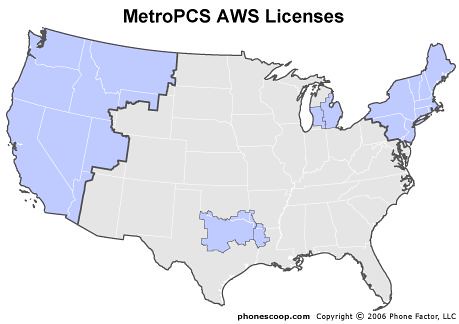
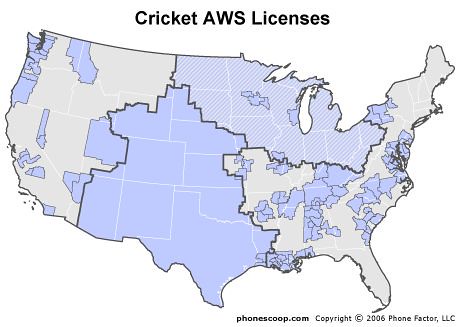
    To understand it roughly, rewind back to the ongoing speculation that a then independent MetroPCS and Leap were a perfect fit since both had the same prepaid business models and did not compete against each other for the most part. The results of the 2006 AWS auction (see graphics below) helped fuel this speculation as the AWS  MetroPCS and Leap spectrum fit provided an uncannily perfectly complement. Time has passed and some AWS licenses changed hands. 


      Graphics from Phonescoop.com
      But with the AT&T-T-Mobile merger breakup, T-Mobile received some AWS licenses and in 2012, Leap and T-Mobile traded some licenses. While the T-Mobile-MetroPCS coverage map looks empty in some areas of the country, that is not to say that the company lacks spectrum in those areas. 
      As seen in the spectrum holdings graphic, the company does indeed have spectrum nationally and can expand if so desired.  


      With the June purchase of Mississippi Valley AWS spectrum from US Cellular (Barat) Wireless) and a future rumored purchase of Leap, the T-Mobile AWS portfolio would be formidable. Aside from T-Mobile, archrival Verizon Wireless' SpectrumCo AWS deal completed in August 2012 and building out this AWS to add LTE network capacity.  


      This competitive landscape would put AT&T in an AWS coverage disadvantage relative to T-Mobile and Verizon Wireless. Therefore, AT&T needed to stay in the AWS LTE game and keep T-Mobile from growing a stronger AWS portfolio. For AT&T, AWS will not only to serve to add LTE capacity customers but also tap into future AWS LTE roaming revenue. T-Mobile, AT&T and Verizon Wireless are logical future roaming partners.  


      Which companies will feel the most impact?

      • For T-Mobile, with Leap as a unit of AT&T, its MetroPCS geographic expansion will be challenged by AT&T's resources.  T-Mobile seemingly has a year or two lead as it is integrating MetroPCS and working on migrating the CDMA base to HSPA+/LTE but the stated goal of 2015.
      • Sprint will lose 3G data wholesale revenue from the agreement forged in August 2010 that expires in Dec 2015. But now Sprint (Clearwire's owner) loses another wholesale arrangement that Clearwire announced in March 2012 though nothing really started.  It's clear now that Sprint's prepaid segmentation strategy was the correct in the long run but Aio Wireless and Cricket are going up against Virgin, Boost, Assurance, respectively. Cricket's logical national (or specific target market) expansion may spell trouble. 
      • Verizon Wireless now sees a stronger AT&T rival with new found AWS and PCS spectrum from Leap. In the long term, it needs additional spectrum to thwart impending capacity brought on with WCS and Channel 55 (700 from Qualcomm) frequencies. In terms of prepaid, its branded prepaid is holding its own but without any flanker brands, competitors will take almost all the future prepaid growth.
      • In infrastructure, AT&T LTE equipment suppliers, Alcatel and Ericsson now have more of an order pipeline than before.

      Last Word

      • The biggest question in this deal is whether the acquisition will pass regulatory hurdles. The sting of the failure to acquire T-Mobile is still fresh in everyone's minds. Like any major deal, it should have been gamed out by M&A internal and external resources taking into account the regulatory environment before it makes the light of day. 
      • If regulatory hurdles are overcome, what conditions will there be? AT&T has proactively said that the Chicago 700 MHz A Block will be sold. (It doesn't like the A block anyway). Will the company need to divest in other markets (planned or unplanned)? 

      Friday, January 25, 2013

      Spectrum Win-Win for Two Giants

      Today AT&T agreed to acquire spectrum in the 700 MHz B band from Verizon Wireless for $1.9 billion in cash and Advanced Wireless Services (AWS) spectrum licenses in several markets, including Phoenix, Ariz., Los Angeles and Fresno, Calif. and Portland, Ore.


      The 700 MHz licenses to be acquired by AT&T cover 42 million people in 18 states — California, Colorado, Florida, Idaho, Illinois, Louisiana, Montana, New Mexico, New York, Ohio, Oklahoma, South Dakota, Tennessee, Texas, Utah, Virginia, Washington and Wyoming.  Here are the following CMAs (Cellular Market Areas):

      ·         California: Los Angeles
      ·         Colorado: Park, Fort Collins-Loveland, Pueblo,
      ·         Florida: Miami, West Palm Beach, Bradenton
      ·         Idaho: Butte
      ·         Illinois: Chicago
      ·         Louisiana: De Soto, Claiborne, Morehouse, Lake Charles, Alexandria
      ·         Montana: Billings, Beaverhead, Great Falls, Carbon
      ·         New Mexico: Grant
      ·         New York: Rochester
      ·         Ohio: Cincinnati, Youngstown
      ·         Oklahoma: Oklahoma City
      ·         South Dakota: Rapid City, Harding
      ·         Tennessee: Memphis
      ·         Texas: Texarkana, Edwards, Waco, Tyler, Longview-Marshall
      ·         Utah: Box-Elder, Carbon, Beaver, Piute
      ·         Virginia: Frederick
      ·         Washington: Okanogan
      ·         Wyoming: Sheridan, Casper

      Yet another interesting sideline is the involvement of a Sarasota, FL private equity firm, Grain Management.  Verizon is selling spectrum in several North Carolina markets to Grain Management. Grain is also acquiring an AWS license covering Dallas from AT&T—and Verizon will lease that license from Grain.
      Recall in Auction 73, the Lower 700 Band was up for grabs.  

      How did Verizon do?


      • Block A – Verizon Wireless and U.S. Cellular both bought 25 licenses each. In this block, Verizon targeted urban areas, while U.S. Cellular bought licenses primarily in the northern portion of the U.S. 
      • Block B – AT&T Mobility was the biggest buyer in the B block, with 227 licenses totaling $6.6 billion. U.S. Cellular and Verizon bought 127 and 77 licenses, respectively. AT&T Mobility and Verizon Wireless bought licenses around the country, while U.S. Cellular continued with its strategy to buy licenses in northern regions. 
      • Block C – Of the 10 licenses in the C Block, Verizon Wireless bought the 7 that cover the contiguous 48 states (and Hawaii). Those seven licenses cost Verizon roughly $4.7 Billion. 


      Why? It's a win-win because Verizon Wireless wanted to unload the 700 MHz bands (A and B Block) as its C Block and its recent AWS spectrum acquired from Cable Company partners gave a sufficient footprint nationally.  AT&T needed it to fill B Block holes nationally.  It was almost a given that AT&T would be the buyer. As an aside, earlier this month,  Verizon sold some A Block licenses to US Cellular. 

      The interesting go-between of a private equity firm is notable.  It's clear that PE firms do not operate networks but a licensing/leasing arrangement from these big carriers will bring in recurring revenue.
        

      Monday, December 10, 2012

      Why Sprint + DISH Makes Sense

      Today's Bloomberg report  suggesting a possible deal where Sprint hosts DISH's spectrum is logical. While DISH has held this spectrum for some time, they have yet to throw services on it. DISH needs a mobile component as all their fixed line rivals (e.g., AT&T, Verizon and Cable Cos) have or will have mobile capability.  The media and industry speculation with Google in mid-November has yet to materialize.

      Keeping Up with Competitors

      From a fixed line view, these competitors are pushing for subscribers being able to access content in any device (i.e., smartphones, tablets, PCs, TVs, cars?). Of course the service provider will love to upsell an alternate access medium to customers. While DISH is a capable satellite provider, it has little experience in the terrestrial side. A national buildout of their MSS spectrum would be capital intensive and outside of their core competency. 

      Enter Sprint

      Sprint's big bet in their 2010 Network Vision strategy that hosting spectrum would be an element of its wholesale strategy. There was much promise as then cable company (SpectrumCo)  partners had a near national AWS footprint and Clearwire needed a platform to expand to new markets. So far, only the nearly defunct LightSquared was the only shortlived spectrum hosting deal. Therefore, any spectrum holder who needed to bring up service is fair wholesale game.  With the Softbank cash infusion,  Sprint has publicly stated that it has the flexibility to do more things.  Aggressively courting DISH and hosting MSS spectrum should be a no-brainer despite any previous tension on MSS spectrum interference with with Sprint PCS operation.

      Possibilities

      It's an inevitability that MSS will run LTE. If MSS bands were to increase Sprint's LTE capability beyond their 5X5 channel implementation, a wider LTE band helps Sprint LTE capacity allowing Sprint's Unlimited data proposition to extend. Speed is another factor in which channels can be aggregated to provide a fatter LTE pipe.  

      A DISH deal allows for a long term alternative (and a lever) to being locked in with Clearwire's TD-LTE. At a minimum, a DISH+Sprint PCS/MSS LTE pipe complements  any data offload.

      Thursday, November 8, 2012

      T-Mobile USA Q3 2012 Highlights - The Five Core Areas

      The T-Mobile USA Q3 earnings release comes in two forms. One is folded in the parent, Deutsche Telekom's overall earnings.  The second is directly through the US unit.  Surprisingly, the expected Five Core Areas of Focus slide that had been a mainstay in the parent's earnings deck didn't make it.  


      However, this was addressed in the US release.   There is no doubt that positive notes will be slotted in any PR/earnings release. Here's what the company had to say and my takeaways in relation to the Q3 earnings news:

      Amazing 4G Services Highlights:

      • T-Mobile continues to advance its $4 billion 4G network modernization plan, which includes installing new advanced equipment that paves the way for the launch of Long Term Evolution (“LTE”) service in 2013.  <<This reinforces the obvious that T-Mobile is spending the necessary money to make it possible for AWS LTE. While the company is aggressive, a 2013 launch is still nebulous. Is it Q1, 1H, 2H? >>
      • Las Vegas and Kansas City were the first cities where T-Mobile customers benefited from the launch of HSPA+ on 1900 PCS spectrum, which delivers enhanced voice and data coverage, as well as faster speeds on unlocked devices such as the iPhone; just yesterday, Washington DC, Baltimore, and Houston also went live.  The Company expects to announce further network strengthening in many additional cities in the coming months.  <<Refarming the PCS spectrum to enable HSPA+ is the foundation for its BYOD (read iPhone switcher - as blatantly stated) strategy. It's tough to fully market speedy iPhone HSPA+ service when the national network isn't there.  When it gets there, the company will certainly make a big splash.>>  
      • In the third quarter of 2012, T-Mobile completed the transaction announced in June 2012 with Verizon Wireless for the purchase and exchange of AWS spectrum licenses in 218 markets across the U.S.  This transaction improved T-Mobile’s spectrum position in 15 of the top 25 markets nationwide. <<Getting more AWS spectrum allows the company to increase its capacity to continue its unlimited data proposition.  An unknown is whether the additional spectrum may be shifted to increase T-Mobile's long term LTE data throughput speed as a marketing differentiation.   With an LTE-Advanced capable network, that's certainly possible to achieve.>> 
      • T-Mobile continued to expand its compelling 4G smartphone portfolio, including adding more devices under the popular Samsung Galaxy lineup, such as the Samsung Galaxy Note 2, and announcing the upcoming availability of two Windows Phone 8 smartphones, including the exclusive Nokia Lumia 810. <<This is a necessary PR item - to continue to show that new and cool halo devices are coming into the portfolio.  In theory, these should be the halo devices being pushed in the Q4 holiday selling season.>>

      Value Leader Highlights:
      • T-Mobile is a champion of “bring your own device (BYOD)” wireless, with affordable value plans that separate the cost of wireless service from the purchase of a new phone. << Value plans are important to court BYOD iPhone users as they get typically a $5 monthly break off 'Classic' subsidized handset plans.  Honestly, this BYOD plan has been around for many years. T-Mobile sees a plus in this since they don't have to subsidize handsets and get better margin from Value customers.  Of course financing new phones continues to be an option for Value plan users. To the customer, it's usually a wash but clearly there are bigger financial benefits for T-Mobile.>>  
      • In early September, T-Mobile launched a new Unlimited Nationwide 4G Data plan that is a key differentiator in the marketplace. <<These prepaid plans provide a compelling alternative to Boost, MetroPCS and Leap plans. With a better national brand, T-Mobile can exploit these plans to take back customers from those rivals.  With 365K branded prepaid net additions in Q3, these plans have to have had an impact in light of MetroPCS' and Leap's Q3 massive net subscriber losses.>>  
      Trusted Brand Highlights:
      • As part of its brand re-launch program, the Company increased investment in advertising to highlight its fast and reliable nationwide 4G network and its blazing fast data speeds in the U.S. <<In the past analyst conferences, T-Mobile and Sprint have always talked about how much their marketing budgets are dwarfed by Verizon Wireless' and AT&T's spend.  Shifting spokeswoman Carly Foulkes from girl next door to woman in control will continue. Honestly, T-Mobile needs to assert its brand to stay relevant in the consumer mindset as Q4 holiday selling begins.  Over the years, we always look forward to what T-Mobile will do for Black Friday. Recall the 'free airline ticket' promotion?>>

       Multi-Segment Player Highlights:
      • In the Business-to-Business (B2B) segment, T-Mobile looks to serve as a trusted communications advisor, helping businesses develop cost-effective, high-value communications programs that meet their business objectives –through bring-your-own-device (BYOD), and mobile device management (MDM) programs as well as attractive international mobility and mobile broadband data plans.  The Company continues to aggressively expand its B2B sales force. << This is a very important area for T-Mobile. As it was consumer-focused for many years, it largely ignored the business space.  Now the company finds itself starting from scratch to build an effective B2B sales force. It's a tough sell as national rivals Sprint, AT&T and Verizon Wireless are very entrenched.  What is T-Mobile's differentiation in this area?  It's not that clear other than the same proposition on the consumer side - value.>>  
      • T-Mobile launched three new Mobile Virtual Network (MVNO) partnerships during the quarter: Spot Mobile, Solavei, and UltraMobile, adding to its existing partnerships with TracFone/SIMPLE Mobile and Roam Mobility. <<MVNOs represent almost  41% of the company's prepaid business and 12% of the customer base. These should have been technically counted as wholesale. >>  
       Challenger Business Model Highlights:
      • The Company continues with its efforts to drive operational efficiencies through the Reinvent program and is on track to achieve $900 million in annual gross cost savings, which the Company has started reinvesting in customer acquisition programs. << The first part of the rather long sentence is about the cost containment is emblematic of every other wireless carrier. But the details on reinvigorating customer acquisition may suggest further marketing spend, whether targeted or more broadly. >>  


      Wednesday, November 7, 2012

      T-Mobile -Thoughts Ahead of the Q3 2012 Earnings Release

      T-Mobile USA is set to release its Q3 earnings and performance metrics on Thursday , November 8th as part of its overall parent's (Deutsche Telekom) Q3 2012 release.  DT's US unit is fresh off an merger/acquisition announcement of MetroPCS in October  and that had grabbed much of the news around the carrier but the Q3 earnings numbers should reveal whether T-Mobile would continue key trends or reverse them.  The company has provided five focus areas throughout previous quarters and many of its Q3 progress points will fit again in these areas.


      Under Amazing 4G Services, we should expect to hear about network progress (LTE buildout) and new halo devices. Under the Value Leader, we should expect to hear about any new services or marketing initiatives. In furthering the Trusted Brand, T-Mobile has been talking about expanding their distribution. For the last two quarters, the company has been putting a lot of effort into opening new 'doors', the first fruits of this may show up in Q3.  With the Multi-Segment Player focus, this is mostly about expanding wholesale (machine to machine/MVNOs) and ramping up the B2B efforts.   Finally the Challenger thrust should roll up cost control and churn containment.  Maybe there will be light shed on acquiring iPhone switchers. However, some performance metrics continue the bellwether of corporate direction. 

      Net Additions:  The trend doesn't look good for the company as its postpaid base continues on a negative trajectory since Q3 2010. On the other hand, T-Mobile's prepaid business is the bright spot in preventing a totally bleak story. The fact that the company has been able to post positive net prepaid additions in an ultra competitive prepaid segment is notable. Throughout the years, prepaid has been on the rise and makes up more of T-Mobile's customer base. In Q2 2010, the prepaid business accounted for about 20% of the base. By Q2 2012, that percentage increased to over 27%.  Q3 looks to increase that percentage.  Switching over to postpaid, the company still needs to reverse the slide.  The unlimited data and plan value story should resonate and pits the company against Sprint's own unlimited data proposition.  How well the company markets to iPhone switching will be a key element in increasing its postpaid pool.
        
      Any increase should signal somewhat to the traction of its expanded distribution strategy.

      Churn:  Looking at prepaid churn, the company is doing a good job in stabilizing that base.  Q3 should continue the downward direction. However, the churn number currently at 6% is very high relative to rivals.  In contrast, Sprint's multi-branded prepaid group posted 3.37% for Q3 while dedicated prepaid plays MetroPCS and Leap are in mid-3% and mid-4%, respectively.  On the postpaid side, the magic threshold for Q3 should be sub 2%. Rival Sprint crossed that mark two quarters ago. T-Mobile remains the only national carrier to be above the 2% postpaid churn mark.

      ARPU: The carrier is also behind in these metrics relative to its national rivals. The downward postpaid ARPU trend is in stark contrast to AT&T, Sprint and Verizon Wireless which has been sloping positively nicely. While AT&T is the postpaid ARPU leader at over $65, Verizon Wireless is T-Mobile's closest ARPU neighbor at $56 in Q2 before they moved to the new ARPA stat. On the prepaid side Sprint remained over the $26 mark in Q3 while regional Leap and MetroPCS are in the 40s.  To move the mark in prepaid, T-Mobile needs to focus on the high-value users. Of course this will be moot in 2013/2014 once MetroPCS starts to get integrated.


      Finally Network: There will undoubtedly be discussion on how well the LTE buildout is progressing. T-Mobile while it pushes its 4G speed (AWS=based HSPA+), it should be stating how the well the PCS refarming is going. This refarming is central to moving ahead with its AWS LTE plans.  The PCS HSPA+ network also serves as the honeypot for additional unlocked GSM iPhone users. Given the jump that other national carriers have in LTE, there should be a mention or reiteration of when T-Mobile expects to launch LTE markets. 


      Thursday, October 25, 2012

      A Clearwire Graphic

      While looking for some Clearwire Q3 Earnings material, this graphic nicely popped up.  It's clear that Clearwire is punctuating its vast national spectrum versus the tier one carriers.

      For those who are curious:
      • Operator A is Verizon Wireless
      • Operator B is AT&T
      • Operator C is T-Mobile 
      • Operator D is Sprint
      Looking ahead for roaming:

      • AWS LTE stands to be a major roaming frequency with Verizon Wireless and T-Mobile in control.
      • PCS LTE roaming should eventually happen. Sprint is the early adopter out of the gate.
      • Cellular 800/850 LTE - big question mark on what will be when AT&T and Verizon Wireless refarms.


      Thursday, October 18, 2012

      Verizon Wireless - Q3 2012 - The Network Fill Story

      As many in the industry know, Verizon Wireless was the first company out of the block with an aggressive LTE buildout schedule. The overall thrust was to mirror its vast 3G geographic footprint by the end of 2013. Now as it has done in the past, its rollout execution has accelerated that timeline and now the company states that it should be done by mid 2013.  


      Why?  The faster it can get a full LTE network, the ability to implement VoLTE advances.  There is an operational cost benefit to this.  Why mirror? There isn't an elegant handoff from LTE to CDMA. And of course, the ability to deliver a data byte is cheaper/more efficient on LTE than EV-DO. Of course that's old news.

      Onto Q3 and what some of the data tells us.  Since LTE is established as the most efficient data platform, the carrier wants its customers to consume data on that network versus 3G.  The question of how many subscribers are actually on the network comes up. In certain circles, the answer will point to return on investment... 

      "You spent so many billions on the LTE network and you only have X% of the base on it?! What are you doing to change that?"   

      In Q3, Verizon has admitted that they've spent substantial marketing into moving people onto the LTE network. Its most reliable network messaging has been supplemented with the largest LTE network and speed messaging to the consumer base.  On top of this, the carrier (like the majority of carriers) are pushing LTE smartphones at various price points marrying that effort with the new shared data plan.

      To that end, Q3 had paid off as highlighted in their earnings slide below.  Most notable is the smartphone penetration hitting 80%.  In previous quarters, mid 70% were good.  Crossing 80% is the goal and the carrier seems at this point to have good momentum going into Q4. The upsell is decent - migrating subs from featurephones to smartphones. Again with only 53% of the base in smartphones, the carrier has a nice upside.

      3G Smartphones Still?! Out of 6.8M smartphones sold, the company doesn't quite provide the LTE smartphone count since 4.5M were LTE devices (which also includes smartphones and modems, tablets & hotspots). Still a clue was divulged when the CFO revealed that 3.1 M iPhones were sold an of those 650K were iPhone 5s (LTE) suggesting the remaining iPhones were 3G - roughly 2.4M. So we can safely say that the iPhone 4/4s though helping out in ARPU/ARPA, those aren't helping to fill the new and shiny LTE network.  These  3G users will likely transition in 2 years unless Verizon entices with an upgrade promotion. By the way, the company is trying to minimize their upgrade percentages to help margins.     

      So the takeaway, 14.9M LTE devices of the 95 M retail sub base on the network -  roughly 16%. Is that good? It depends on internal Verizon Wireless planners and financial types' expectations.  For certain, this is an important metric to pay attention to in subsequent quarters for every carrier deploying LTE.

      Wednesday, October 17, 2012

      Leap LTE - Burning the Candle at All Bands

      Leap (Cricket) is comparatively a slow mover in LTE deployment. Its first market began as a test market in December 2011 in Tucson, AZ. Just today, Leap launched its second market, Las Vegas. 

      The commonality between the two announcements have been the only release device being the Huawei Boltz USB modem at $149.99 or as my analyst brethren (rounds down) say $149.  Though many carriers have traditionally launched with modems first, carriers have traditionally taken a lot of heat over the lack of other devices (yes, smartphones) at launch.  Leap follows continues the trend with more smartphones in the pipeline.   


      Service Innovation Unrecognized

      For those who follow Leap, it's perplexing why they are emphasizing mobile broadband plans as they have been de-emphasizing their 3G mobile broadband plans. Leap has been bleeding 3G mobile broadband customers for many quarters. Perhaps some of it was planned as those customers had no data caps and pounding the 3G network for relatively inexpensive price points.  Perhaps the new LTE data plans stand to be more profitable.

      $50 Plan - 5 GB @ 3 Mbps
      $60 Plan - 5 GB @ 6 Mbps

      The company doesn't get credit for its speed-dependent rates.  This model follows the fixed line internet model where one pays more for faster throughput.  Back to the modem which may appear archaic in today's WiFi hotspots like the (also Huawei) Crosswave.
      It's likely that Leap wants to control the data consumption to protect the network and customers alike.  

      Lots of Future LTE bands  

      Here is where Leap seems to be schizophrenic with its LTE strategy and burning the candle at all bands, making things complex.  These latest markets have been launched using AWS bands.  Earlier, Leap signed on with Clearwire in March 2012.  Yet there is another band in the mix - 700 MHz A Block (Chicago only).  This came about with the swap with Verizon Wireless approved in August.  So let's recap what Leap will need to support in the coming years:

      • AWS LTE
      • 700 MHz LTE (Chicago-only, what's that all about?)
      • 2.5 GHz TD-LTE 

      It's safe to say that multi-band support is giving device makers challenges but on top of this, it's safe to inject other LTE roaming band support into the mix. Still, the carrier has promised 21 million POPs covered by the end of the year. Network engineers and installation people must be frantically working.