Quintel Blogger theme

A free Premium Blogger theme.

Showing posts with label Q4 2012 earnings. Show all posts

Monday, January 20, 2014

Bullet Point Analysis: Verizon Wireless' Share Everything Plan Minor Adjustment

WHAT IS IT?

Several tech news and blogger outlets have reported that Verizon Wireless will add a new 250 MB plan (at $20) level to its Share Everything plans as of January 21, 2014.

ANALYSIS

Big data users invariably dismiss this 250 MB level as miniscule, and it is. But there are two  areas why this makes sense. 


  • First - Migrate the featurephone base to Smartphones and Share Everything Plans.  The Share Everything plan is now the only postpaid plan vehicle to migrate customers off legacy voice-centric plans (e.g., America's Choice - remember that?).  The new data-centric plan is also inexplicably linked to smartphone penetration.  Since 1Q2013, an Share Everything plan slide has been every quarterly earnings presentation deck.   


In 2Q 2013


In 3Q 2013


Verizon Wireless wants steeper curves on smartphone penetration and postpaid Share Everything account migration.  Here are the illustrative results since 3Q 2012. 


Since 4Q 2013 earnings is around the corner, it's likely to assume that smartphone penetration should cross 70% given the company's track record.  We can also safely assume that once Verizon Wireless nears the 100% Share Everything plan goal, there will be another more important growth slide to take its place. 
 
  • Second - Provide a lower price point for featurephone users to convert to data. Previously, the lowest data price point was at $40 and provided 500 MB. Logically and in sales positioning, $20 and 250 MB is half.  While veteran smartphone users cringe at the low data level, Verizon Wireless is betting that once a non-data user starts to use data, they will get hooked and move up subsequent next tiers.  Increasing data usage is closely linked with helping increase Verizon Wireless' average revenue per account (ARPA) metric.
COMPETITIVE IMPACT?

Some may believe that this is Verizon Wireless' action against AT&T revamping its Mobile Share plans back in December 2013.  When laid out, we find that the new plan is in fact less competitive to AT&T. AT&T still has the advantage for Verizon Wireless switchers at the low data levels.    Given the above logic, the new $20/250 MB level will not get featurephone switchers. Those who are making the smartphone jump are likely to have explored T-Mobile or Sprint.


Still Verizon Wireless' opportunity may be in the existing range of data bucket choices with more price points and advantage in addressing the small business and high data use consumer accounts.   

Looking ahead, if history repeats itself, Verizon and AT&T users will start getting a handle of monthly data consumption and adjust accordingly. Once that happens, the number of data levels should shrink and (ideally for customers) price points will decrease.

Monday, March 11, 2013

4Q2012 Prepaid Carrier Trends – Be Warned – It’s A Long One

Now that the Q4 2012 earnings are done, let’s look at the segment that had been driving a lot of the wireless growth in the past few years – prepaid. Rewind back to 2007/2008, Leap and MetroPCS were strongly acquiring subscribers with their unlimited propositions. The subsequent years saw similar flat rate introductions from the likes of Boost, Virgin Mobile, Tracfone’s StraightTalk and NET10. With the pressure from the monthly prepaid plans, Tier 1 carriers Verizon Wireless, AT&T and T-Mobile also joined the mix. The commonality in competition is for the high-value user. The traditional pay-as-you-go (PAYG) user’s contribution is far less. These users range from ‘glove box’ (low use) to moderate users. They also tend to be highly price sensitive and have a higher churn profile. The opposite is true to monthly plan users. These users while also price sensitive are heavier users and are fine with a flat rate model for predictability. They often have a lower churn profile relative to the PAYG user. That’s not to say they’re in the postpaid sub 2% churn territory. But for the prepaid segment, these monthly users are lower churn. 

Smartphones have been appearing in the prepaid segment for the last two years. While the companies want to offer the same capabilities as the postpaid segment, the prepaid model calls for low to no subsidies on devices. Of course companies strive to find low cost providers (e.g., Huawei and ZTE) to fill that niche and to leverage price against existing suppliers (e.g., Samsung, LG, Kyocera, HTC, etc.). The goal of course is to drop the smartphone price so that buyer can perceive that they’re affordable. However, prepaid providers walk a fine line for inexpensive devices because if a device is perceived as almost a throwaway, the likelihood of churn increases. For those reasons, expensive halo devices like a Samsung Galaxy S3 or the Apple iPhone keep the carrier sticky. 
With this as a backdrop, let’s look at how the players fared? Purely on net addition numbers, we can see that the regional unlimited players that ruled the day back in 2007/2008 are in trouble with Leap Wireless in the poorest shape with over 300K in subscriber losses. In Leap’s earnings call they noted that they are de-emphasizing their pay-as-you-go and mobile broadband business. There is logic in this as mobile broadband users eat more bandwidth (leaving less for monthly users) and PAYG are less revenue generating. MetroPCS though with less subscriber loss follows the same loss trend that has plagued Leap for many quarters. The company claims that they’re de-emphasizing CDMA growth but this tactic has resulted in an overall 5% loss in the base. This meshes with the long term strategy anyway once T-Mobile integrates and eventual use the 1900 CDMA to convert to 1900 HSPA+. By contrast, Tracfone’s net additions are by far the most impressive. The company buys wholesale from many carriers and has a large mix of PAYG and a growing base of monthly users. Presumably StraightTalk is doing well for the company as evident in ARPU. Several years ago, Tracfone ARPU was 10. In Q4 2011, it was 16 and in Q4 2012, it is now 18. APRU just doesn’t jump like this by growing a purely PAYG product. 


While Verizon Wireless had a tremendous Q4 in the postpaid side with over 2.1M net adds, the positive prepaid numbers indicate their competitiveness. Despite a down from a year ago and the previous quarter, it speaks to their premium brand messaging and perhaps a new November double data plan promotion. This is pretty decent for a predominately postpaid company. AT&T on the other hand is on a steeper downward slide. In Q3 2012, the company added 77,000 users with those gains erased with the 166K lost in Q4. AT&T is still a postpaid company with prepaid making up around 7% of the total subs. It will be interesting to see which way the direction turns for AT&T in Q1 2013. Another predominately postpaid carrier doing well in prepaid is US Cellular. Though the regional carrier continues to shed postpaid subscribers, the new U Prepaid plans that it has partnered with Alltel may be helping the cause. 

Moving onto the rest of the carriers, Sprint’s prepaid numbers have been down relative to previous quarters because the Assurance brand that had been driving huge subscriber count has been slowed due to FCC’s revamping of the subsidized Lifeline program in 2012. The company has already warned of a 1.2-1.3M subscriber loss possibly in Q2 2013 due to the revamping of rules. Regardless, the company indicated that the Boost and Virgin Mobile brands have contributed to the positive numbers. At the same time, the company is actively trying to migrate older Boost iDEN users off ahead of the iDEN network decommissioning. Finally, T-Mobile’s prepaid business is offsetting continued losses (550K) on the postpaid side. Again the above numbers are branded prepaid. T-Mobile counts MVNO (wholesale) net additions as prepaid as well. Branded prepaid at end of year 2012 represented 17% of the overall T-Mobile base. Looking ahead with the combination of MetroPCS’ prepaid subs, branded prepaid will transform to 45% of T-Mobile’s subscriber count. Given the higher churn profile of prepaid and lower revenue, it’ll looks challenging for future higher revenue contribution. But that’s months away…. Q1 2012 typically continues Q4 sales momentum. We’ll visit that to see what develops.

Thursday, March 7, 2013

US 4Q2012 Carrier Results - Google Hangout with RCR Wireless

Dan Meyer, Editor in Chief of RCR Wireless asked me to discuss Q4 2012 carrier results and some thoughts on some future direction.


Thursday, November 15, 2012

Q4 2012 - Raining Tablets at AT&T

In the October Q3 2012 earnings call, AT&T Mobility President and CEO Ralph de la Vega addressed the Q4 outlook for net additions to be based on tablets. The broader view of course is is to stimulate data adoption and revenue.  He said,

"We also anticipate a higher number of net adds from tablets in the fourth quarter."

Further at the November 7 AT&T Analyst event in which the $14 billion wireless/wireline investment (Project Velocity IP) was announced,  Mr. de la Vega addressed tablets again in the Questions and Answer session in the context of Windows 8 support and Q4.  


He stated, "It's gonna rain tablets."

Given these statements, let see what AT&T has planned to realize that projection. There are three views on net additions. First, there are direct LTE-equipped tablets that are available within the AT&T portfolio.  Second, there are the indirect benefit of WiFi equipped tablets stimulating wireless broadband adoption from mobile hotspot devices.  Lastly, there is the wholesale component that customers such as Amazon's will offer tablets with built-in data. 

In this post, we'll focus on the direct customer purchase view, the backbone of AT&T's effort to stimulate mobile share plan adoption and tablet rainmaking is a $100 tablet discount/two-year commitment promotion. This was announced on November 9th.   

The AT&T tablet portfolio should mirror the handset portfolio philosophy   That is to provide customers with the widest array of choices in operating systems and price points.  Each tablet is mobile broadband enabled (no surprise).  Going into the Windows 8 launch, the company's tablet offerings centered around the Apple iPad  and several Android-based offerings from HTC, Pantech and Samsung. Looking at the emerging AT&T tablet portfolio in Q4, several initiatives and products have been announced since the earnings call. To provide choice and OS diversity, Windows has been introduced.  Below are the device announcements since the late October earnings call.

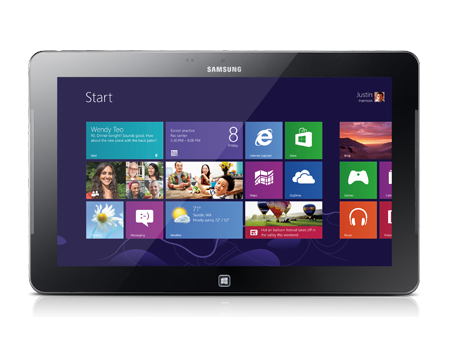
  • November 5 - Samsung ATIV smart PC, a full Windows 8 tablet at $799.99 without a contract, $699.99 with a two year commitment. A WiFi-only ATIV smart PC is not available.  


Samsung Galaxy Tab 10.1, an Android-based (Ice Cream Sandwich) tablet offered at $499.99 without a contract. A Wi-Fi only Tab 10.1 currently has an average selling price of $350.


  • November 13 - Asus VivoTab RT($699.99 retail), a Windows RT platform device. The Asus announcement showcases the $499.99 promotional price which includes a free mobile dock/keyboard and extra battery. However, this deal is contingent on a Windows Phone smartphone purchase to knock it down $100 ($599.99) and a two year data plan commitment arrives at the final $499.99 promotional price. A WiFi-only VivoTab has an ranges from $550-$600. 


The device announcements have indeed provided a spread in price points. In the past, manufacturers were criticized on the high cost of a mobile broadband connected tablet (~$130) relative to the WiFi-only option.  Now with the $100 discount and mobile share plan options, AT&T seeks to minimize that price gap.  Still with a consumer eye, the price points may not be that appeal to the mainstream.  However with an eye towards small business and enterprise, the offerings may be palatable.  The difference now than before, aside from the price promotion, is that Windows 8 may bring business traction. With Microsoft as a enterprise friendly brand, Office, Exchange and VPN support among other security features helps Windows 8 receptiveness. A mobile broadband connected that is IT friendly makes the case for workforce mobility and productivity. 

Back to the consumer view, Q4 has a lot of room left for announcements but as Black Friday approaches, many selling companies start seeding the consumer mindset for the holiday buying. As the weeks progress, AT&T should be announcing additional vendors. As more announcements are made, we'll keep a running tally and opine whether the raining tablets scenario seems credible enough to push up Q4 net additions.