Quintel Blogger theme

A free Premium Blogger theme.

Showing posts with label LTE. Show all posts

Thursday, January 2, 2014

LTE Speed Titles

AT&T has already taken the LTE speed mantle for 2013.  I think that speed will continue to be an important marketing differentiation.  Sprint Spark, based on 2.5 GHz spectrum as that opportunity to break Sprint out of its downward slide.  


My article in RCR Wireless entitled LTE Speed Crowns and Network Dependencies lays out some of my thoughts.  A key piece in increasing speed is when carrier aggregation kicks in. In a nutshell,   it's the ability to piece together disparate pieces of a carrier's spectrum portfolio to make a 'fatter pipe' in order to deliver to the user, a faster speed (and lower latency) experience. Of course there are a lot of hardware dependencies that go into it.

While speed is exciting, what looks to be a Sprint win may be a marketing and revenue loss in the non-metropolitan areas.  That is due to 2.5 GHz's poor propagation characteristics.  It just cannot reach out there and Sprint's problem is that thought it has a lot of the frequency, in order to make it effective nationally, they would have to expend a LOT more money to blanket the U.S. geography. This is a similar argument that you don't see a fully geographic national PCS network.  Verizon Wireless and AT&T will have that advantage with their sub-1GHz portfolio. When these larger carriers piece their deep cellular bands with their 700 spectrum, they will have the ability to deliver greater speed than Sprint outside of the metropolitan areas.  This won't happen for a couple more years late 2015-2017, perhaps.   

Sprint will need to execute on its 2.5 GHz Spark buildout to have a shot at the standard speed surveys that Root Metrics (various metro updates over the course of the year) and PC Magazine (May) performs. It may be that Sprint will win some important metros but may not get the 2014 title until those survey cities are 'Sparked.'  Throwing a monkey wrench in 2014 will be Verizon Wireless and T-Mobile tapping their deep AWS assets. T-Mobile has already been reported to have a 20 X 20 (20 MHz down/20 MHz uplink) in the Dallas area while Verizon Wireless has turned on  20 X 20 in New York.

When Spark reaches some critical market threshold, I fully expect Sprint to turn up the marketing to push speed and unlimited.(And introduce a deep Tri-band device portfolio). It should definitely appeal to the technology forward users.  I'm also thinking that the tech blogs should help the cause. Of course, it depends on getting that network going. 

2014 will be an interesting speed year.  

Wednesday, November 6, 2013

3Q13 U.S. Tier 1 Carrier Results - A Conversation

I had a chance to talk to RCR Wireless' Dan Meyer on Tier 1 third quarter carrier results.

Read it at RCR Wireless here:: AT&T & Verizon Wireless

View it:


Read it at RCR Wireless here: Sprint and T-Mobile 

View it:

Thursday, October 10, 2013

Bullet Point Analysis: T-Mobile's Un-carrier 3.0 - The International Card


WHAT IS IT?

T-Mobile announced its Un-carrier 3.0 initiative. The 3.0 portion follows the Un-carrier strategy that the company unveiled in March 2013 to address "customers' pain points" and ultimately set the company on track to retain and grow marketshare.

As a recap, this slide from the 2013 Q2 earnings release summarizes the company's Un-carrier moves thus far.


Un-carrier 3.0 in a nutshell:
 
 
WHAT'S IN IT FOR T-MOBILE?

  • Strategic Promise, Disruption and Differentiation: T-Mobile is delivering on a strategy that addresses customers' pain points. Previous iterations were doing away with contracts, early handset upgrades and lower service pricing by decoupling the overt handset subsidy. From a marketing viewpoint, this provides more advertising fodder to drive customer acquisition attack ads.
  • Growing the Business Subscriber Base: Let's face it, T-Mobile has always been a consumer centric brand. Prior to its network buildout thrust, its network could not compete against larger competitors AT&T, Verizon Wireless, and Sprint, who had the business sector sewn up, especially globe trotting enterprises. In the 2Q 2013 earnings call, CEO John Legere subtlely telegraphed B2B as an area of 'coming attractions.'  Legere even admitted that the "percentage of gross additions were too small to get concerned with..." With this as a backdrop, the international roaming angle of Un-carrier 3.0 is a boon to target globe trotting business customers to grow its B2B business.
  • Driving International Calling: While stateside international calling can be costly for T-Mobile, one should be reminded that its prepaid brand, MetroPCS announced unlimited stateside "international" calling for $5 back in 2009. So a cost-effective (some believe VoIP-based) infrastructure is already in place.
  • Impacting Profitability?: One would think before any of these moves gets off the ground, there are business cases supporting the effort. While unlimited data roaming may sound like a money loser, it's all relative for several reasons. First, the roaming impact may be thought as the cost to acquire a coveted business subscriber base that is less price sensitive than the consumer segment. The business base and the additional lines (and the overall customer spend) may offset the cost of data roaming.  Second, there are parallels to the introduction of unlimited calling where a steady state and predictable monthly consumption develops. It's unlikely to think business travelers are constantly streaming video abroad - more consumer behavior. For consumers, a slower abroad data experience may provide frustration and curtail that behavior. Finally, the $10/month stateside international calling tacks helps offset some of the overall costs. Besides, as the slide above states, T-Mobile is targeting to have the lowest cost structure in the industry.

WHICH COMPANIES WILL FEEL THE MOST IMPACT?

  • Clearly T-Mobile is going after its bigger competition, AT&T, Verizon Wireless and Sprint to grab business switchers.  This segment tend to have higher ARPU/ARPA than consumers. The proposition is formidable as anyone who has traveled and paid for roaming can attest. Magnify this to multinational enterprises in which roaming is a substantial expense and expense managers will quickly look at T-Mobile's Uncarrier 3.0 option.  T-Mobile business sales teams now have this and a growing domestic LTE national network to provide credibility in sales calls.  
  • It's likely that competitors will see some business subscriber leakage with a compelling offer as unlimited international data and text roaming.  Competitors are already playing up slower roaming data experiences but unless they can prove that a T-Mobile roaming customer receives a slower experience than their own roaming partners, they're in the same boat (held hostage as the destination's partner network). Yet the percentage of global travel will determine an organization's business case for switching. Further, it will depend on the generation of handset for higher speed support abroad.  LTE roaming is almost non-existent so the default will be HSPA+ (in some countries dual carrier HSPA+ is possible) or EDGE roaming.
  • A possible scenario may be that T-Mobile 'lines' will be purchased for international business. This approach will provide a known US number for easy contact rather than to purchase an in-country SIM card. So the customer may have both a domestic and international phone/line.  Either way, T-Mobile stands to gain subscriber lines and if they can prove domestic network parity in the long term, total switching will become a viable scenario.
  • On the stateside international calling front, VoIP providers such as Skype may feel some impact as the simple ability to direct dial can trump launch an OTT app on a computer or handset.    

COMPETITIVE RESPONSE?

It remains to be seen if competitors will match T-Mobile's unlimited data and text roaming offer. To some extent, they are handcuffed as their enterprise bases are large and international roaming revenue, decently profitable. Loyalty and network breadth (domestic and international) will be a piece of the counter argument. However, Un-carrier 3.0 is a formidable challenge that will need to be addressed. Key indicators will be customer inquiry for a competitive response, roaming revenue declines and customer voluntary churn.  What form it will take and how quickly a solution rolls out depends on customer defection.  Regardless, product planners will be in meetings to figure out their company's response alternatives. 

Thursday, July 25, 2013

Bullet Point Analysis: MetroPCS's 15 New Market Expansion & New Handsets

MetroPCS had multiple announcements. The first announcement focuses on expanded its smartphone portfolio with the Nokia Lumia 521 ($99) and LG Optimus F3 ($149). While handset announcements are less than notable on a strategy, there are small tidbits that one can glean. They are:

  • The  smartphones are not CDMA. This is a step to migrate the subscriber base to the T-Mobile network (100% goal in 2015) .
  • The Lumia is an HSPA+ only device and comes from the T-Mobile prepaid device stable. Moreover, it give MetroPCS a Windows Phone choice.
  • The LG Optimus F3 is HSPA+/LTE. Other carriers have the F3 in CDMA configuration. The F3 has better processor specs than the postpaid Optimus L9 offering. So the prepaid version bests a postpaid offering, albeit a tad smaller (4" vs 4.5" screen).   

The second press release was more interesting.  MetroPCS announced 15 new markets, expanding their total market reach to 30 markets.  With this announcement, the company has opened up for business in those markets along with distribution.  However, Metro will wait until September 1 for their advertising push. 

Of the 15 markets, 8 are Leap markets. T-Mobile's CEO has talked up a head-to-head match up against Leap. Interestingly some are in Texas, a Leap stronghold. One symbolic market that stands out is San Diego - Leap's corporate headquarters.  Key to the success will obviously be distribution - big box stores such as Best Buy and third party retailers. The company is looking for 200 doors in August with more in the fall.
  • Baltimore, MD - Head-to head against Leap/Cricket
  • Birmingham, Ala. - New market without retail Leap presence; Next major city that links up with Atlanta market
  • Cleveland and Akron, Ohio - adds to Great Lakes coverage
  • Corpus Christi, Texas - Head-to head against Leap/Cricket
  • Fresno, Calif. - Head-to head against Leap/Cricket
  • Houston, Texas - Head-to head against Leap/Cricket
  • Memphis, Tenn. - Head-to head against Leap/Cricket
  • New Orleans, LA  - New market without retail Leap presence
  • Rio Grande Valley, Texas  - Head-to head against Leap/Cricket
  • San Antonio and Austin, Texas - Head-to head against Leap/Cricket
  • San Diego, Calif. - In Leap's backyard (its headquarters)
  • Seattle and Tacoma, Wash. - In T-Mobile's HQ area, no brainer in opening up distribution in the parent's backyard; New market without retail Leap presence
  • Tallahassee, Fla. - Rounds out MetroPCS's Florida coverage. New market without retail Leap presence
  • Toledo and Sandusky, Ohio - adds to Great Lakes coverage; New market without retail Leap presence
  • Washington, DC - Head-to head against Leap/Cricket

Sunday, July 14, 2013

Bullet Point Analysis: The AT&T-Leap Buyout


What is it?


AT&T is buying prepaid player Leap Wireless for $15 per share in cash. Under the terms of the agreement, AT&T will acquire all of Leap’s stock and wireless properties, including licenses, network assets, retail stores and approximately 5 million subscribers. AT&T expects the transaction to complete in 6-9 months (1H 2014).

What is in it for Leap?


  • For shareholders and management, they can exit the cut throat prepaid business with money. Leap and similar regional prepaid player, MetroPCS, had once enjoyed strong growth until a couple of years ago. National competitors and prepaid MVNOs ate into their marketshare and growth. T-Mobile's acquisition of MetroPCS that closed in May 2013 logically put a brighter spot light on Leap. 
  • For Leap operations, the Cricket brand expands its geographical reach beyond Leap's limited regional footprint and can go head-to-head against MetroPCS and can tap into AT&T's distribution resources.
  • For the Leap network, it has a clearer LTE path. Operating CDMA (96M POPs) and LTE (21M POPs) in the same limited AWS spectrum bands doesn't work well.   

What is in it for AT&T?


Spectrum:  

  • Complementary PCS and AWS bands covering 137M POPs, some of AWS is not in service (41M POPs).
  • Proceeds from the Leap 700 A Block spectrum goes into the deal calculus.


Subscribers and Doors: 
  • Leap has 5 million prepaid subscribers but the company has been trying to right itself after steady customer losses that began in Q2 2012. AT&T increases its prepaid customer base to roughly 12 million, roughly 11% of the AT&T total subscriber base.
  • Leap's distribution channel numbers a little less than 9,000 doors.  
  • Commentary: Leap's business needs a turnaround that Leap's management has been trying to accomplish for more than a year. In that time, Leap lost about 900K customers. Leap's distribution also slimmed down from over 11K doors in a bid to focus customer acquisition.  AT&T's own branded prepaid is not growing. The launch of the Aio brand in May allows for the company to enter the prepaid market aggressively without diminishing the AT&T brand. Now that Leap joins the AT&T prepaid fight, the strategy is shaping up to match the segmentation strategy pioneered by Sprint (Boost, Virgin, Assurance) and Tracfone (Tracfone, StraightTalk, Net10, Simple Mobile, PagePlus, and Safelink). T-Mobile also joins in the prepaid segmentation fight with its own GoSmart and MetroPCS).  All this Tier-1 competition and the plethora of MVNOs out there vying for the prepaid share of wallet will make for thin margins.  
Strategic Positioning:

Keeping T-Mobile Away: There are many who say this is a spectrum deal. That is true that additional PCS and AWS spectrum enhances the AT&T network, I argue that a large element is to neutralize a growing T-Mobile threat. Fresh off the May close of MetroPCS, T-Mobile supplemented its AWS spectrum with a $308M deal with US Cellular at the end of June.  
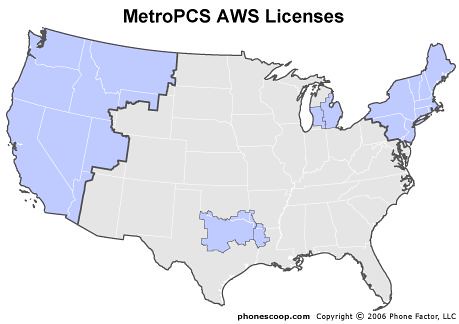
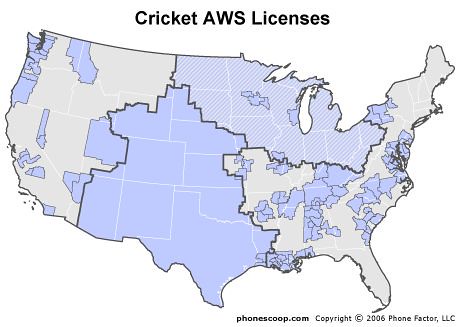
    To understand it roughly, rewind back to the ongoing speculation that a then independent MetroPCS and Leap were a perfect fit since both had the same prepaid business models and did not compete against each other for the most part. The results of the 2006 AWS auction (see graphics below) helped fuel this speculation as the AWS  MetroPCS and Leap spectrum fit provided an uncannily perfectly complement. Time has passed and some AWS licenses changed hands. 


      Graphics from Phonescoop.com
      But with the AT&T-T-Mobile merger breakup, T-Mobile received some AWS licenses and in 2012, Leap and T-Mobile traded some licenses. While the T-Mobile-MetroPCS coverage map looks empty in some areas of the country, that is not to say that the company lacks spectrum in those areas. 
      As seen in the spectrum holdings graphic, the company does indeed have spectrum nationally and can expand if so desired.  


      With the June purchase of Mississippi Valley AWS spectrum from US Cellular (Barat) Wireless) and a future rumored purchase of Leap, the T-Mobile AWS portfolio would be formidable. Aside from T-Mobile, archrival Verizon Wireless' SpectrumCo AWS deal completed in August 2012 and building out this AWS to add LTE network capacity.  


      This competitive landscape would put AT&T in an AWS coverage disadvantage relative to T-Mobile and Verizon Wireless. Therefore, AT&T needed to stay in the AWS LTE game and keep T-Mobile from growing a stronger AWS portfolio. For AT&T, AWS will not only to serve to add LTE capacity customers but also tap into future AWS LTE roaming revenue. T-Mobile, AT&T and Verizon Wireless are logical future roaming partners.  


      Which companies will feel the most impact?

      • For T-Mobile, with Leap as a unit of AT&T, its MetroPCS geographic expansion will be challenged by AT&T's resources.  T-Mobile seemingly has a year or two lead as it is integrating MetroPCS and working on migrating the CDMA base to HSPA+/LTE but the stated goal of 2015.
      • Sprint will lose 3G data wholesale revenue from the agreement forged in August 2010 that expires in Dec 2015. But now Sprint (Clearwire's owner) loses another wholesale arrangement that Clearwire announced in March 2012 though nothing really started.  It's clear now that Sprint's prepaid segmentation strategy was the correct in the long run but Aio Wireless and Cricket are going up against Virgin, Boost, Assurance, respectively. Cricket's logical national (or specific target market) expansion may spell trouble. 
      • Verizon Wireless now sees a stronger AT&T rival with new found AWS and PCS spectrum from Leap. In the long term, it needs additional spectrum to thwart impending capacity brought on with WCS and Channel 55 (700 from Qualcomm) frequencies. In terms of prepaid, its branded prepaid is holding its own but without any flanker brands, competitors will take almost all the future prepaid growth.
      • In infrastructure, AT&T LTE equipment suppliers, Alcatel and Ericsson now have more of an order pipeline than before.

      Last Word

      • The biggest question in this deal is whether the acquisition will pass regulatory hurdles. The sting of the failure to acquire T-Mobile is still fresh in everyone's minds. Like any major deal, it should have been gamed out by M&A internal and external resources taking into account the regulatory environment before it makes the light of day. 
      • If regulatory hurdles are overcome, what conditions will there be? AT&T has proactively said that the Chicago 700 MHz A Block will be sold. (It doesn't like the A block anyway). Will the company need to divest in other markets (planned or unplanned)? 

      Wednesday, July 10, 2013

      Analysis: T-Mobile’s "Boldest" Move - JUMP and Simple Choice forFamilies

      What is it?

      • T-Mobile announced an equipment upgrade program known as  JUMP!™, which enables people to upgrade their phones when they want, up to twice a year as soon as six months from enrollment. The monthly outlay is $10/month with equipment warranty (theft, lost, broken, or when one wants another phone).
      • The Simple Choice for Family plan (4 lines of unlimited talk, text and web(500MB) for $100/month) was also announced allowing access to discounted  plans without a credit check. The caveat is that payment must be in advance (prepaid).


      • JUMP Details: 
        • Enroll in JUMP for $10/month. Have to wait for 6 months until the first 'JUMP' to get a new device. 
        • If in 'Good Working Order' (powers on, no screen cracks, no visible water damage), customer can get the next latest and greatest. If customer is financing it (Equipment Installment Plan (EIP)), remainder of payments are waived. Customer can enter a new EIP plan.
        • If not in 'Good Working Order,' a deductible will be paid ranging from $20-$170, depending on device,
        • Customer can upgrade twice a year. It could be as early as the next day. 

      What it means for consumers:
      • For T-Mobile consumers who are early adopters and want the latest and greatest, Jump should be very compelling.
      • For T-Mobile customers who don't care for upgrading and are price-sensitive, they're not likely to enroll in JUMP as the enrollment tallies to $120 a year.  
      • For credit challenged family customers who want access to discounted postpaid rates, this should spur them on.
      • The JUMP plan should appeal for early adopters in other competitors. Since T-Mobile is targeting AT&T, it would be logical for T-Mobile to step up some anti-AT&T marketing as it has done so already.

       What it means for T-Mobile:
      • JUMP is an interesting anti-churn tool that appeals to a segment of customer who is willing to switch to get the latest and greatest. For this reason, it comports with T-Mobile's public comments stating that 2013 is going to be a year to stabilize.
      • JUMP may be an effective switching tool. If T-Mobile can convince potential switchers that the T-Mobile network is just as good as everyone else's that would help customer acquisition.  
      • The long term impact of JUMP 'trade-in' devices will help its MetroPCS unit.  These turned in devices will be refurbished and pushed into the MetroPCS portfolio as refurbished. For the MetroPCS customer who normally pays full priced for a phone, access to nearly the latest and greatest smartphone at a lower cost increases service stickiness. As T-Mobile wants to transition MetroPCS customers from their CDMA phones anyway, this move can potentially help accelerate the migration to the LTE/HSPA network and refarming of MetroPCS PCS spectrum. 
      • Depending upon the JUMP subscriber size, the $10 monthly fee may be a factor in lifting postpaid ARPU.
      • Simple Choice for Family should also help T-Mobile acquire subscribers. The price point is compelling. This plan could draw price sensitive postpaid family subscribers from competitors as well as transition families dealing with individual prepaid plans. How much this will hit Tracfone brands like StraightTalk and Simple Mobile remains to be seen. Of note, Simple Choice is LTE accessible whereas MVNO plans are still 3G/HSPA (okay 4G-ish). 

      ·          
      Which companies will feel the most impact?


      • AT&T as the very public target should see the most marketing against its subscribers. Other competitors may experience some leakage from their early adopter community as well, especially those whose ending contracts. 
      • T-Mobile warranty companies should be busy depending upon how well JUMP is embraced.
      • Handset makers (likely with halo devices) will likely see more volume coming out of T-Mobile. With increased volume, T-Mobile may leverage this to attain more favorable pricing. 

      Thursday, June 27, 2013

      DISH Folds & Some DISH Options

      Poker 

      As the long multi-hand poker game with Sprint, DISH, Softbank and Clearwire dragged on with DISH upping the ante, forcing Sprint and Softbank to push, DISH folded on both deals in the end.

      DISH's game to takeover Sprint ended on June 18, 2013 when they withdrew their offer. The press release language implied that they will devote their resources to win Clearwire. It didn't look bad when the Clearwire board recommended DISH's offer back on June 12. 
      But with a higher Sprint offer on June 20, the coup de grace came several days later on June 24 when the Clearwire board reversed its DISH recommendation for Sprint's offer.  


      DISH folded on its second poker hand with yesterday's June 26 announcement. Many including me, expected another run, upping the ante, given DISH's playing profile but what did it have to gain? Really - nothing.

      DISH's Options

      The near term scenario is that DISH needs to get service up and running. Any time you're delayed means lost future revenue opportunity. With its core business slipping, there is urgency to get into the mobile space. Given this line of thought, it needs to bury the hatchet with Sprint and move to spectrum hosting.

      A long term scenario is that DISH can wait until an alternate hosting provider comes on line. T-Mobile has been bandied about as that partner.  But why not Verizon Wireless and AT&T? Everyone wants access to new spectrum and if the deal is right, anything is possible. 

      Regardless of scenario, DISH and a partner(s) need to seed the mobile ecosystem on DISH's bands. Technically, it may not be a stretch. However, the lead times to quickly  create/productize the chipsets and integrate into production hardware (device and infrastructure) are still an issue. Once it joins the mobile service provider club, DISH can upsell its own customers on mobile broadband (either fixed or mobile) and wholesale its capacity.  

      Looking ahead, DISH is looking for another game but it may not be poker. 


      Thursday, February 7, 2013

      Tier 1 Q4 2012 Smartphone Growth and the iPhone

      Now that three Tier 1 carriers have reported their Q4 results, here are some observations and commentary on smartphone growth.  As most industry people know, smartphones are the hot user commodity. Smartphones serve many purposes from a churn reduction tool, to ARPU uplift (offsetting voice revenue decline) to increasing operational efficiency (move data consumption to a more data efficient (capacity and throughput to the LTE network). But the old 3G network also has legs so for now, wholesale (MVNOs & M2M) and prepaid can extend return on old investment there.

      iPhones have been a catalyst for increased carrier data revenue. AT&T's past  iPhone exclusivity has allowed it to accumulate a massive customer base that proven to be low-churn and loyal. With the exclusivity gone, other carriers (through Apple's deal-making and carriers' realization that an iPhone is competitive table stakes) also jumped on the iPhone bandwagon.  The notion that iPhone is such a powerful sales acquisition and retention tool has played out again in Q4 2012.

      For the big three, AT&T, Sprint, and Verizon Wireless, smartphones sales/activations continue to be on a positive track.  AT&T reported 10.2 million smartphone sales in Q4, while Verizon Wireless came close at 9.8 million, and Sprint posting 6.1 million. These added up to 26.1 million smartphones.  The interesting observation is how many of these smartphones were iPhones.

      • AT&T - 8.6 million
      • Verizon Wireless - 6.2 million
      • Sprint 2.2 million

      As a percentage of the overall Q4 smartphone sales, iPhones activations accounted for:

      • AT&T - 84%
      • Verizon Wireless - 63%
      • Sprint - 36%
      On the whole among the three Tier 1 carriers, the iPhone accounted for 65% of smartphone activations. 


      Impressive stats for sure. With contenders from BlackBerry (BB10 OS), Microsoft (Windows Phone 8) and Android, can the iPhone in the U.S. continue its run?  I submit that this hinges on Apple innovation.  As I've said previously, Apple needs to innovate, as its user interface (UI) is aging with incremental innovation.  Customers have a lofty expectation of radical things for each iPhone (and iPad) model.   Apple needs to deliver in 2013 or the early adopters (and then the mainstream) will move on.   

      Monday, January 7, 2013

      MetroPCS Q4 and 2012 Results - Ouch

      MetroPCS released their Q4 2012 and year to date 2012 results ahead of the Q4 earnings call later in the month. What stands out is the surprise subscriber loss over the year. 


      With over 93K subs lost in what is supposed to be a hot Q4 holiday selling season,  the results suggest that the prepaid sector is as cut throat and competitive as ever. The result of these losses invariably is a function of its gross additions.  The simple theory goes, if you have a good distribution and acquisition network, you can help offset the subscriber losses and in an optimal scenario, come out ahead.

      MetroPCS' gross additions were also down in Q4 and end of year compared to 2011.  Churn is down a small bit at 0.1% or 10 basis points in financial speak. It's a small win.  There are other metrics that can help tell the story of what's going on such as EBITDA/OIBIDA margin, ARPU, CPU and CPGA but we'll have to wait on that.  While this may look bad, one can give MetroPCS the benefit of a sliver of doubt assuming that they could be letting go of low-value or high-risk users for more profitable customers.

      Yet the prepaid sector is very competitive with many similar offerings from Tier 1 competitors (Verizon Wireless, T-Mobile, AT&T, and Sprint prepaid brands Boost Mobile and Virgin Mobile) and MVNOs such as Tracfone's Straight Talk and Net10.  Another worry may be any hint of distributor apathy ahead of the mid-2013 T-Mobile-MetroPCS transaction. While T-Mobile intends to retain the MetroPCS brand, MetroPCS better figure out how to reverse subscriber losses before the deal is consummated.

      Monday, December 17, 2012

      Sprint and Clearwire - It had to be - Network Future?

      Now that Sprint will acquire the remaining 50% of Clearwire that it already did not own, what does this say about the near term and future?  While there are many stories about the financial side, most industry insiders knew that the Clearwire acquisition was a strategic imperative. Back in October when Sprint moved to take more control, I offered some thoughts  on why Sprint's long term control of Clearwire made sense. Much of the logic is rooted in the long term network strategy.

      Network Vision

      Sprint's network strategy hasn't changed since 2010 with the introduction of its Network Vision.  Many analysts derided the price tag and its hosting positioning but today, Sprint's bet seems to have turned out well.

      When Sprint announced Network Vision in 2010, it seemed a bit presumptuous that 2.5 GHz was included into the spectrum chart especially since Clearwire had not committed to the effort and especially Sprint did not control any of that spectrum.  Clearwire had its own separate network deployment strategy with capital already sunk in specific markets using WiMAX to power Sprint's 4G data play. 


      In order to expand markets, it was logical that Clearwire take advantage of Network Vision but that didn't happen. Executive tensions (between Sprint and Clearwire), the need for Clearwire corporate independence and lack of capital to expand contributed to stalling the grand Network Vision execution.  With the urgency to stay in the LTE game against wireless competitors, Sprint worked with Clearwire on specific markets to deploy the TD-LTE flavor in specific 'high data tonnage' markets.  It was clear, Clearwire would provide the complement to Sprint's near term PCS-based LTE strategy.  

      Fast forward to 2012, what has changed?  The answer - Softbank.  Though the Softbank-Sprint acquisition approval is scheduled for mid-2013, Softbank's $3.1B bond purchase in October freed Sprint to make specific strategic moves beyond Clearwire in the form of US Cellular subscriber and spectrum acquisition in November. 

      Back to the 'new' Sprint network,  surprisingly, the network slide hasn't changed.  To Sprint's credit, they're executing on their vision.


      But what has changed is a bit more detail specific to LTE.  Today's 800 MHz band primary is envisioned for voice. With better in-building penetration properties, having voice is still the 'bread and butter' revenue bearing service.  800 also hosts the soon to be discontinued iDEN platform. Eventually 800 will also run LTE with VoLTE.  However, 800 LTE is more than 2-3 years away. The near term LTE solution is in the PCS band. But with only a 5 X 5 deployment and also running 3G, the analyst community questioned whether this could handle increasingly high-data usage especially in light of an unlimited data service proposition. 

      Enter TD-LTE and Clearwire

      To address high data use, Sprint engaged Clearwire in a data offload arrangement.  Rather than a national TD-LTE view, Sprint would identify specific high-data tonnage markets for Clearwire to buildout its TD-LTE. The concept: with plenty of 2.5 GHz spectrum, Clearwire (and Sprint) could address subscriber [retail and wholesale (think data MVNOs)] capacity and still offer a speed differentiation. Yet with an independent Clearwire, Sprint clearly had no control of its future. Therefore, it was a strategic imperative for Sprint to take over Clearwire.   Sprint also had to act as the financial community was advocating Clearwire sell "excess" 2.5 spectrum to raise cash.  This flies in the face of any network planner as history has shown that spectrum always appreciates and the overused 'spectrum is the lifeblood of a network' adage still holds.

      Two "2.5 GHz Dollar" Questions 

      Assuming that the Clearwire acquisition goes through, will Sprint expand or accelerate the original Clearwire deployment plan?  I say yes, they have to eventually.  Whatever the TD-LTE markets previously agreed upon, it only address specific high density markets.  To offer a broader coverage story that rivals competitors, Sprint will need to show a bigger TD-LTE footprint.  It's taken for granted that a data-offload (of PCS LTE) strategy is still in play.  

      There are two questions in my mind that Sprint need to address.  First, a broader future question is when Sprint will exploit the national 2.5 GHz coverage.  With a national footprint, Sprint ensures a richer wholesale platform and deeper capacity.  Sprint strategy guys have likely played this scenario out.  With less than ideal propagation (relative to 800 (and 700)), small cells and associated backhaul will play a prominent role (read more capital).  The second is more of a technical question.  When will Sprint take advantage of its potential speed advantage. With aggregating spectrum, Sprint can position speed and unlimited as a marketing differentiator much like Verizon Wireless' coverage.  Of course the answer is when the TD-LTE ecosystem commercially supports this on the infrastructure and device side.

      Stay tuned for more Sprint moves in 2013. 

      Wednesday, November 28, 2012

      Raining Tablets at AT&T? A Portfolio Status Report

      Earlier in the month, we took an initial look at the AT&T tablet portfolio to determine the progress of consumer choices there were.  Since that post, one addition, the iPad mini joined the portfolio on the 16th of November.  


      Here's how the tablet portfolio looks (online without refurbished models).

      Manufacturer
      Models & WWAN
      OS
      Apple
      iPad 2 (3G) 16GB, 
      iPad (current gen LTE) 18, 32, 64GB, 
      iPad mini (LTE) 16, 32, 64GB
      iOS
      Asus
      vivoTab RT (LTE)
      Windows 8 RT
      Pantech
      Element (LTE)
      Android
      Samsung
      Galaxy Tab 8.9 (LTE), 
      Galaxy Tab 10.1 (LTE), 
      ATIV (LTE)
      SmartPC (LTE)
      Android
      Android
      Windows 8 
      Windows 8


      To AT&T's credit, the portfolio has 8 tablet models and many memory level iPad choices. So rather, AT&T has 7 iPad models to sell.  This expands the portfolio to 13. At this snapshot in time (after Black Friday), will there be additional announcements ahead of holiday shopping? There may be one or two in the wings but any more tablets creates too many choices which is a problem itself.  Carriers wish to optimize its inventory and SKU count, balancing choice with carrying costs.

      While AT&T has high tablet net add hopes, let's look at Verizon Wireless' online portfolio (without refurbished models).  There is a similar apples-to-apples comparison since this carrier also offers a shared data plan.  


      Verizon Wireless Tablet Portfolio     


      Manufacturer
      Models & WWAN
      OS
      Apple
      iPad 2 (3G) 16GB, 
      iPad (current gen LTE) 18, 32, 64GB, 
      iPad mini (LTE) 16, 32, 64GB
      iOS
      Motorola
      DROID XYBOARD 8.2” (LTE)
      DROID XYBOARD 10.1” (LTE)
      Android
      Android
      Samsung
      Galaxy Tab 2  7” (LTE), 
      Galaxy Tab 2 10.1” (LTE), 
      Android
      Android

      Verizon Wireless' portfolio offers the same choices on Apple products but is limited to Android support. This isn't that much of a surprise as the carrier has just started supporting Windows Phone 8 smartphones. Verizon Wireless' 11 models isn't far off from AT&T's 13.  What is different is each carrier's approach. AT&T is offering an aggressive $100 discount while Verizon Wireless has no such incentive. However, the $100 discount requires a two year contract whereas Verizon Wireless allows month to month.

      From the carrier view, a two-year subsidized plan is good for overall churn reduction and ensures customer data use. Of course US consumers have yet to be acculturated to tablet data and like smartphones it will be a multi-year endeavor to create the demand. 


      Monday, November 19, 2012

      Thinking about the 4G Coverage POP/Market Race - 1


      The latest in the LTE coverage race: Verizon Wireless' latest network statement states that the company has hit 441 LTE markets. AT&T has also announced its expanded 103 LTE markets/150 million POPs covered on top of the overall 285 million POPs on its 4G HSPA+ network.   

      Coverage and then there is coverage

      The POP or population covered and market race is on again for 4G/LTE coverage. Carriers had been battling in this numbers race back when 3G was introduced.  Population covered had been the norm in showing coverage. However, that is just one component of market positioning.  The other one is geography.  From the national map view, Verizon Wireless is pretty much in the driver’s seat with the 2008 Alltel acquisition.  To Verizon Wireless’ credit, the carrier has been effectively exploiting its geographic advantage and is central to the “Why Verizon Wireless?” marketing strategy.  


      Why haven't AT&T and other tier one carriers T-Mobile and Sprint matching geography coverage?  Simplistically, these carriers are more or less taking a population density approach.  They are covering where most people are using their phones. As one carrier analyst relations professional explained in the past, “We’re not going to build a network to cover cows.” There is financial logic to that as capital expenditures are scrutinized by investors.  What’s the return on investment on covering cows?  Does a company really have enough capital to match Verizon Wireless’ geographic coverage? The short answer is yes but some are in better financial shape than others.   In the 3G realm, forging roaming agreements becomes the equalizer.  For example, Sprint got the map coverage to largely with an agreement with Alltel (pre-Verizon Wireless takeover).  


      Leap in another example uses Sprint as its main roaming partner.   


      Therefore, the operational cost of roaming outweighs the capital cost in building a network in specific markets.  Besides, the ability to provide coverage and connection to customers is extremely important in light of the expectation of US national coverage.  This is all fine for 3G networks but as the industry moves to LTE, a different marketing dynamic takes hold which fuels this vicious coverage arms race again.

      The next post the complexities and confusion that 4G and LTE bring…